
Understanding Google Algorithm Updates
Indeed, Google is always busy improving its functionality, making it more efficient for people who use the services of the company. One way to achieve that is by frequently adjusting algorithms that are responsible for showing certain websites in search results depending on their relevancy and other factors.
This process of updating the algorithms used to sort the websites in the search results is usually referred to as an algorithm update. It should be noted that algorithm updates aim at one goal—to provide people with search results that are useful and answer their queries, and not just a collection of keywords meant to trick the algorithm.
Thus, with time, websites learned to focus not on their rankings but on their relevance to real problems of their readers. This resulted in websites becoming honest and valuable sources of information people may use without hesitation.

How Google Algorithm Updates Changed Website Rankings
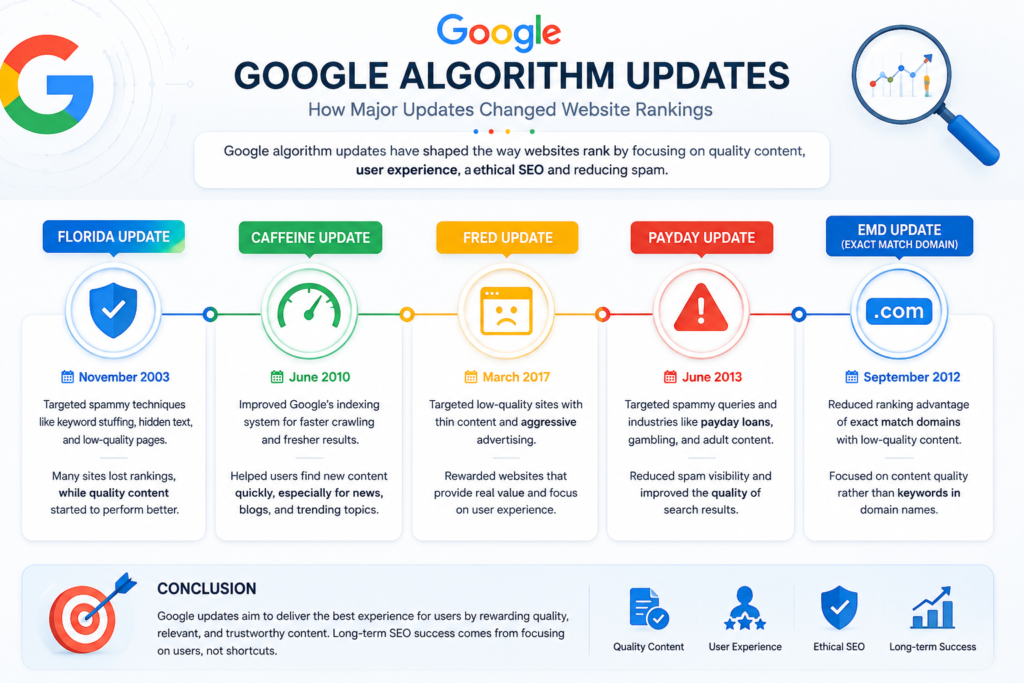
The algorithm updates by Google have long-term consequences for the ranking of web pages in search results. Many updates were released by Google in the past years; some of them include the Florida update, Caffeine update, Fred update, Payday update, EMD update, etc. These updates aim at enhancing the quality of search results provided and helping users get better results. Every website owner and digital marketer should be aware of the impact these updates may have on their ranking.
- Florida
- Caffeine
- Fred
- Payday
- EMD (Exact Match Domain)
1. Florida
Florida Update — November 2003
The Florida update was the first big Google algorithm change way back in November 2003. This update was a game changer in the SEO world because it penalized websites that used spammy tactics to rank higher in search results. There was a lot of keyword stuffing, hidden text, and crappy pages created just to game the rankings at the time on many sites.
Google’s Florida Update was designed to improve search results and provide users with more relevant and trustworthy content. Old-fashioned SEO tactics sent many sites tumbling in the rankings and traffic overnight. But sites with really good content started to get better.
The Florida Update was a turning point in SEO history that alerted website owners that long-term success comes from quality content and honest optimization, not shortcuts.
2. Caffeine
Caffeine Update — June 2010
Google introduced the Caffeine Update in June 2010 to make the search indexing system faster and more efficient. Caffeine changed how Google gathered, stored, and refreshed the web content that appears in its search results, unlike past updates that mostly impacted rankings.
Prior to the Caffeine update, Google took longer to index new web pages and updates. Also, this update allowed Google to crawl and index content a lot faster, meaning users would be able to see fresh and newly published information a lot faster in search results. This was particularly true for news websites, blogs, and trending topics that needed to be seen in real time.
The Caffeine Update encouraged website owners to post new, quality, and regularly updated content. It also helped make the overall search experience better by making Google search results faster, more relevant, and more up-to-date for users around the world.
3. Fred
Fred Update — March 2017
Google rolled out the Fred Update way back in March 2017 to clean up search results and target websites that cared more about making money than helping users. Websites loaded with ads, thin content, and clickbait-ish articles dropped a lot in the rankings. The update made it so website owners had to make content that was more helpful, reliable, and reader-friendly, instead of chasing traffic for ad revenue.
Large drops in organic traffic and ranking were seen on websites that published low-quality articles or actively monetized their content.
The update is a reminder for website owners and digital marketers that user experience is more important than shortcuts. Google stressed that sites should concentrate on producing high-quality, authentic content useful to readers rather than trying to get more clicks and earnings.
4. Payday
Payday Update – June 2013
The Payday Update by Google was rolled out in June 2013 in an effort to combat very spammy search queries as well as websites that try manipulating the search engines in order to boost their ratings on the search engine page results. Most spammy sites were concentrated in particular niches, which include payday loans, gambling, adult services, and any other niche with heavy competition.
Prior to the Payday Update, some of these websites were using tactics such as keyword stuffing, unnatural backlinks, and misleading content in order to rank well among search engines. Payday Update aimed to minimize the ranking of these types of websites in favor of more genuine and relevant sites.
As expected from this algorithm change, the unethical SEO websites saw their rankings go down significantly, while ethical sites saw theirs increase significantly.
5. EMD (Exact Match Domain)
EMD (Exact Match Domain) Update — September 2012
The EMD algorithm was launched by Google in September 2012 to prevent low-quality sites from attaining good rankings simply because of matching their domain names with commonly used search terms. Prior to the EMD algorithm, sites gained rankings solely on the basis of including exact search terms within their domains irrespective of the poor or irrelevant content.
Through the use of the EMD algorithm, Google focused on delivering quality content and better user experience. Sites that had low relevance were penalized for low quality, whereas useful sites maintained their rankings.
This update proved that good SEO requires quality content and credibility rather than keywords only.
Conclusion: The Lasting Effects of Google Algorithm Updates
As seen in the examples of the many algorithm updates that Google has carried out in recent times, it is clear that each time an update takes place, it brings about lasting effects on the structure of websites. The updates such as the Florida, Caffeine, Fred, Payday, and EMD updates were carried out so as to bring about better search quality and make websites contain only good content and no spam SEO techniques.
Understanding the various algorithm updates carried out by Google is important for all digital marketers and businesses since SEO has always changed over time.